- Details
A Wagon Train Tragedy: Testing a Family Story with Records and DNA
In 1940, a woman known in our family as "Aunt Alpha" wrote a letter to her niece, Barbara Richardson. Among the family news and reminiscences was the account of a wagon train tragedy that had been passed down for more than a century.
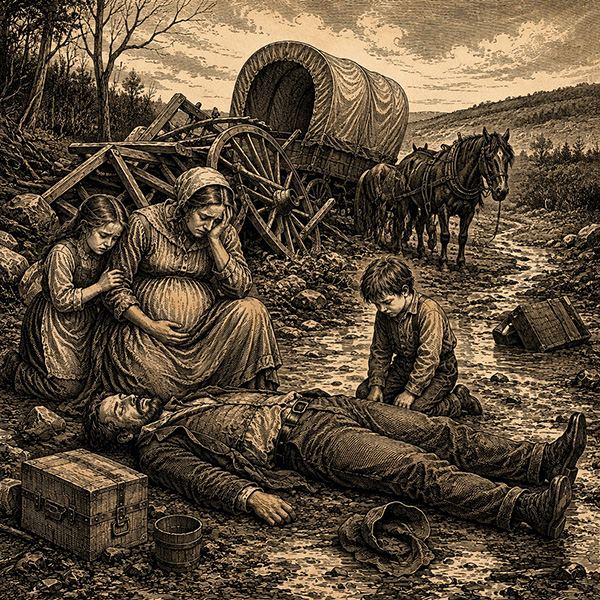
The story concerned Margaret Gebhard, an Ohio pioneer whose parents reportedly died while migrating west from Pennsylvania. According to the account, Margaret's father was killed when he fell beneath a wagon team during the journey. Her mother died shortly afterward, leaving several children orphaned. Relatives traveling with the family supposedly took the children into their care and continued the trip to Ohio.
By itself, the story was intriguing. What made it particularly interesting was its source.
Twenty years earlier, in 1920, Alpha had interviewed her grandmother, Celestia Key Richardson, the eldest daughter of Margaret Gebhard Key. Celestia was then an elderly woman in her eighties and one of the closest living links to the family traditions surrounding Margaret's childhood. According to Alpha, however, Celestia had little interest in revisiting the subject. When questioned about the events, she reportedly brushed them aside as "water under the bridge."
The 1940 letter was therefore not a simple recollection from a single individual. It represented Alpha's effort to preserve information gathered from both her grandmother Celestia and her Aunt Della, who supplied additional details about the family's past.
More than a century separated the letter from the events it described. Could those memories still be traced in the historical record?
Could a wagon train tragedy remembered across four generations be verified through documentary records and DNA evidence?
Following the Trail of a Wagon Train Tragedy
Research into early nineteenth-century families can be challenging. Civil death records were often nonexistent, and surviving documentation may be scattered across multiple jurisdictions.
Fortunately, the loss of parents frequently generated records of a different kind.
When minor children were left without parents, courts often became involved. Guardians were appointed. Estates were administered. Property had to be managed until children reached adulthood. These activities generated paperwork that can survive long after other records have disappeared.
As I examined probate files, guardianship records, land transactions, and other contemporary documents, a picture began to emerge.
The records revealed a family whose circumstances closely matched the story. Multiple minor children appeared in guardianship proceedings. Estate records documented the legal consequences of parental deaths. The documentary evidence demonstrated that the children had indeed lost their parents while still young and that other adults assumed responsibility for their care.
The records did not repeat the story word for word—and they rarely do. Instead, they provided independent evidence that allowed the major elements of the tradition to be evaluated.
Testing a Wagon Train Tragedy with DNA
The documentary record suggested that Margaret Gebhard belonged to a particular family, but could that conclusion be supported by genetic evidence?
DNA testing provided an opportunity to examine descendants of several members of the extended Gebhard family. If the documentary evidence was correct, descendants of Margaret and descendants of her proposed siblings should still share inherited segments of DNA despite the passage of six generations.
The DNA evidence pointed in the same direction. Multiple descendants tracing back to different branches of the family shared DNA in patterns consistent with the relationships suggested by the documentary record. No single DNA match proved the case. Rather, the value of the evidence lay in the collective picture created by many matches examined together.
As with documentary research, DNA evidence rarely provides simple answers. Individual matches can be misleading or open to multiple interpretations. When analyzed alongside probate records, guardianship proceedings, and other contemporary documents, however, the genetic evidence provided an independent line of support for the conclusions drawn from the historical record.
The records preserved the story of a family. DNA provided evidence that the descendants of that family remain connected more than two centuries later.
What the Evidence Revealed
Neither the records nor the DNA evidence repeated the family story exactly as it had been remembered. Together, however, they revealed a family whose experiences closely mirrored the traditions preserved by later generations.
The documentary record established the deaths of Margaret’s parents and the subsequent guardianship of the surviving children. DNA evidence provided independent support for the family relationships suggested by those records.
Viewed separately, each source offered only part of the picture. Together, they transformed a long-preserved family tradition into a historical question that could be examined through evidence.
The Story That Survived
The letter that survives today was not written by someone who witnessed the events it describes. Instead, it represents an effort to preserve family memory before it disappeared.
More than a century separated Aunt Alpha’s letter from the deaths of Margaret Gebhard’s parents. During that time, details were forgotten, memories faded, and some parts of the story undoubtedly changed. Yet the central tragedy endured.
A young girl lost both parents. Relatives stepped forward to care for the surviving children. The family continued westward and eventually built new lives in Ohio.
The records do not tell the story exactly as the family remembered it. They never do. What they reveal is something perhaps more important: beneath the family tradition was a real family facing real loss on the American frontier.
For more than a hundred years, descendants carried fragments of that memory forward—from Margaret to her daughter Celestia, from Celestia to Alpha and Della, and ultimately to Barbara Richardson. Because they preserved those fragments, the story survived long enough to be examined, tested, and better understood.
Not every family story proves true. But sometimes a story remembered across generations contains far more history than anyone realizes.
Learn more about DNA services or 👉 Contact me today to schedule your consultation.
- Details
Professional Genealogical Research: The Carolyn Carlwitch Case Study
At gDetective, professional genealogical research begins with a mystery. She appeared on a single line of an 1891 New Orleans marriage license — the mother of the bride, entered as Carolyn Carlwitch. That was it. No birth date. Her name showed up nowhere else in the family's records. For a family trying to trace their roots, she was a wall.
For us, though, she was a starting point.
How Professional Genealogical Research Solved the Carolyn Carlwitch Mystery
At gDetective, we approach every research question like a detective approaches a case. Structured planning, rigorous evidence standards, and a commitment to proving — not guessing — our conclusions define how we work.
The "Carolyn Carlwitch" question illustrates exactly what that looks like in practice.
When a family came to us with this mystery, the name itself was the first clue. "Carlwitch" matches no surname from a recognizable tradition. However, 19th-century American clerks routinely garbled foreign names. They heard unfamiliar words and spelled them phonetically. Over time, we have learned to read through those distortions.
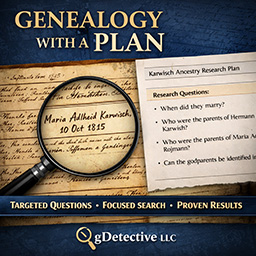
We started by working backward from the marriage license. Next, we cross-referenced passenger manifests, census records, and New Orleans civil documents. Finally, we traced the family to German Catholic parish registers in the Diocese of Osnabrück. Together, those sources established — to the Genealogical Proof Standard — that "Carolyn Carlwitch" was Maria Adelheid Karwisch. She was born October 9, 1815, in Schwagstorf, in what is now Lower Saxony, Germany.
As a result, a woman invisible to her descendants for over a century finally had a name, a birthplace, and a story.
What You Receive from Professional Genealogical Research
Every conclusion we reach is documented in a structured written report. It can stand up to scrutiny, pass down to future generations, and serve as a foundation for future research. Additionally, our reports include full source citations and analysis of conflicting evidence. Each conclusion clearly states what we have proved versus what remains possible. We don't paper over uncertainty. Instead, we document it honestly.
A GPS Proof Summary
For identity questions or lineage claims, we produce a dedicated proof argument. It shows precisely how the evidence meets the Genealogical Proof Standard — the field's benchmark for a sound genealogical conclusion. Therefore, you'll know not just what we found, but why we're confident in it.
A Forward-Looking Research Plan
Answering one question almost always opens the door to the next. For example, when we proved Maria Adelheid Karwisch's identity, the natural follow-up was: who were her parents? We produced a detailed research plan with specific research questions and prioritized source targets. Consequently, the work can continue in a clear, methodical direction. No more wandering. No more guessing.
Multi-Archive Sourcing
Tracing immigrant families means working in multiple languages and across multiple countries. Moreover, it often requires record collections that most researchers don't know exist. In the Karwisch case, for instance, we drew on German Catholic parish registers and civil records from the Niedersächsisches Landesarchiv in Osnabrück. We also pulled Louisiana vital records and U.S. census data. Furthermore, we evaluate all of those sources together to build a coherent picture. We handle the archive navigation so you don't have to.
Honest Communication About Evidence
We will never tell you something is proved when it isn't. We distinguish carefully between what the records demonstrate, what they suggest, and what remains unknown. That honesty is what makes our conclusions trustworthy — and meaningful.
The Human Story Behind the Records
Maria Adelheid Karwisch never set foot in America. She died in Germany before her family made the crossing. Her name, however, survived the Atlantic in her daughter's memory. When Adeline gave her mother's name to a New Orleans clerk in 1891, the clerk wrote down "Carolyn Carlwitch." Consequently, a German woman who never left her homeland became invisible to the very descendants who carried her memory.
That's what we're here for. Perhaps your family mystery is a garbled name on a document. Maybe you have an immigrant ancestor with no paper trail. Or perhaps your lineage seems to vanish in the mid-1800s. In any case, we bring the methodology, the archival access, and the patience to find answers.
Ready to start? Contact us at gdetective.com
Jeffrey L. Evensen is the founder of gDetective LLC and a professional genealogical researcher specializing in German immigrant families and GPS-standard research and reporting.

- Details
When the Story Begins with an Object
It didn't start with a document.
There was no diary, no bundle of letters, no detailed memoir passed down through the family. Instead, the story began with an object—a small piece of wood shaped by careful hands more than a century ago. It had been kept, moved, and protected through generations, valued even when its full history was no longer remembered.
At first, it was simply a family heirloom. Then it became a question.
Who made this? Where did the skill come from? Was it something learned at home, through a trade, or through formal training? And perhaps most importantly—what did this object reveal about the life behind it?
- Details
A solid DNA methodology is important for the many genealogists who rely on DNA evidence to answer difficult family history questions. Developing a sound DNA methodology is essential when working with results from multiple testing companies.
Each company uses different tools, reference data, and reporting formats. These differences can make it difficult to compare results directly or evaluate how much weight to give a particular match or segment. Genealogists often encounter uncertainty when trying to interpret findings across platforms.
Read more … A Behind-the-Scenes Look at My DNA Methodology Project
- Details
Old Family Letters: Clues or Proof?
Every genealogist loves finding an old family letter. The handwriting connects us across time, and the stories can make our ancestors feel alive in a way that bare records cannot. But as with all sources, letters require careful handling.
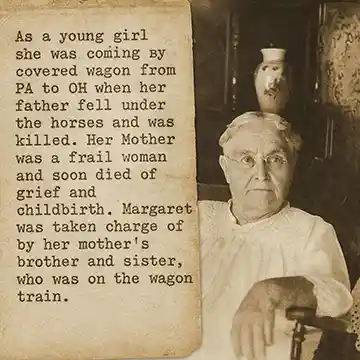
One family document I was sent many years ago is a letter written by “Aunt Alpha” (Alphina Richardson), granddaughter of my ancestor Margaret Gephart’s daughter, Celestia. In her recollections, Aunt Alpha shared a dramatic story about how Margaret’s father died in a wagon accident on the family’s move from Pennsylvania to Ohio, and how her mother soon passed away from grief and childbirth. Margaret, she wrote, was then taken in by her mother’s siblings who were traveling in the same wagon train.