Professional Genealogical Research: The Carolyn Carlwitch Case Study
At gDetective, professional genealogical research begins with a mystery. She appeared on a single line of an 1891 New Orleans marriage license — the mother of the bride, entered as Carolyn Carlwitch. That was it. No birth date. Her name showed up nowhere else in the family's records. For a family trying to trace their roots, she was a wall.
For us, though, she was a starting point.
How Professional Genealogical Research Solved the Carolyn Carlwitch Mystery
At gDetective, we approach every research question like a detective approaches a case. Structured planning, rigorous evidence standards, and a commitment to proving — not guessing — our conclusions define how we work.
The "Carolyn Carlwitch" question illustrates exactly what that looks like in practice.
When a family came to us with this mystery, the name itself was the first clue. "Carlwitch" matches no surname from a recognizable tradition. However, 19th-century American clerks routinely garbled foreign names. They heard unfamiliar words and spelled them phonetically. Over time, we have learned to read through those distortions.
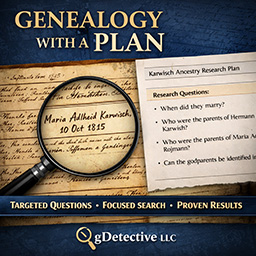
We started by working backward from the marriage license. Next, we cross-referenced passenger manifests, census records, and New Orleans civil documents. Finally, we traced the family to German Catholic parish registers in the Diocese of Osnabrück. Together, those sources established — to the Genealogical Proof Standard — that "Carolyn Carlwitch" was Maria Adelheid Karwisch. She was born October 9, 1815, in Schwagstorf, in what is now Lower Saxony, Germany.
As a result, a woman invisible to her descendants for over a century finally had a name, a birthplace, and a story.
What You Receive from Professional Genealogical Research
Every conclusion we reach is documented in a structured written report. It can stand up to scrutiny, pass down to future generations, and serve as a foundation for future research. Additionally, our reports include full source citations and analysis of conflicting evidence. Each conclusion clearly states what we have proved versus what remains possible. We don't paper over uncertainty. Instead, we document it honestly.
A GPS Proof Summary
For identity questions or lineage claims, we produce a dedicated proof argument. It shows precisely how the evidence meets the Genealogical Proof Standard — the field's benchmark for a sound genealogical conclusion. Therefore, you'll know not just what we found, but why we're confident in it.
A Forward-Looking Research Plan
Answering one question almost always opens the door to the next. For example, when we proved Maria Adelheid Karwisch's identity, the natural follow-up was: who were her parents? We produced a detailed research plan with specific research questions and prioritized source targets. Consequently, the work can continue in a clear, methodical direction. No more wandering. No more guessing.
Multi-Archive Sourcing
Tracing immigrant families means working in multiple languages and across multiple countries. Moreover, it often requires record collections that most researchers don't know exist. In the Karwisch case, for instance, we drew on German Catholic parish registers and civil records from the Niedersächsisches Landesarchiv in Osnabrück. We also pulled Louisiana vital records and U.S. census data. Furthermore, we evaluate all of those sources together to build a coherent picture. We handle the archive navigation so you don't have to.
Honest Communication About Evidence
We will never tell you something is proved when it isn't. We distinguish carefully between what the records demonstrate, what they suggest, and what remains unknown. That honesty is what makes our conclusions trustworthy — and meaningful.
The Human Story Behind the Records
Maria Adelheid Karwisch never set foot in America. She died in Germany before her family made the crossing. Her name, however, survived the Atlantic in her daughter's memory. When Adeline gave her mother's name to a New Orleans clerk in 1891, the clerk wrote down "Carolyn Carlwitch." Consequently, a German woman who never left her homeland became invisible to the very descendants who carried her memory.
That's what we're here for. Perhaps your family mystery is a garbled name on a document. Maybe you have an immigrant ancestor with no paper trail. Or perhaps your lineage seems to vanish in the mid-1800s. In any case, we bring the methodology, the archival access, and the patience to find answers.
Ready to start? Contact us at gdetective.com
Jeffrey L. Evensen is the founder of gDetective LLC and a professional genealogical researcher specializing in German immigrant families and GPS-standard research and reporting.